
Brain on Music Education 106: Brainstem Changes following Music Education: Another Piece of the Puzzle or another Puzzling Piece?
Christopher Viereck, PhD, Neurobiologist in residence, Music Empowers Foundation
It is wonderful to be back with another Column. We will continue to explore and explain why early music education is important for our children not only for bringing pleasure and fulfillment but also because of the additional benefits in other learning areas.
This month�s column focuses on a topic covered in 2 related articles, recently posted by The Music Empowers Foundation: A New York Times article "Brain Waves Stay Tuned to Early Lessons" and a recent post on the Scientific American blog: "Even a Few Years of Music Training Benefits the Brain". Both cover a new finding from a research group at Northwestern University in Evanston Illinois: Music lessons in childhood, which began at an average age of about 10-years ? even if only 1-5 years in duration ? led to persistent brainstem changes for up to an average of about 7-years. Let�s review what was done and how the results fit in with what we have learned in other Brain on Music Education Columns.
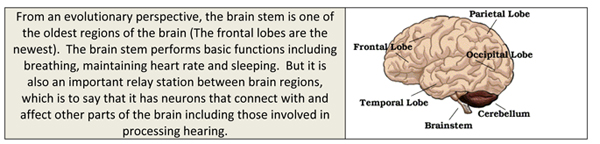
First, a quick lesson on the brainstem: You may recall the image below from the first Column (101: "What Transpires in the Brain on Music Education?"):
The research group at Northwestern, led by Dr. Kraus, measured the auditory brainstem responses (see explanation in the box below) from three groups of children: One group had received no musical training, the second group (described above) had received 1-5 years of instruction while the third group received 6-11 years of musical training. The auditory brainstem measurements were taken between 3.3 and 7.2-years after the musical instruction. An equivalent time was used for the children who had no prior musical training. The ratio of boys to girls, ages and IQ were comparable between the 3 groups. These similarities between the 3 groups are important. The researchers were careful to balance these and other factors. They wanted to make certain that any differences in brainstem measurements were due to differences in brainstem activity and not due to the sex, age or IQ differences of the children in each group.
The researchers found that the characteristic Auditory Brainstem Responses (ABRs) spikes were greater in size for the 2 groups of children who had previously had musical training compared to the group that had not received any training. There did not appear to be any differences in the size of the ABRs between the 2 groups of children who had received 1-5 or 6-11 years of musical training. The researchers also found that there was less of an increase in the size of the spikes with longer times between the last musical training and the ABR measurements. The electric signal changes from the brainstem from early music training do not appear to persist forever (i.e. "use it or lose it")
What do the results mean? The results suggest that musical training confers individuals with the ability to better process complex sounds. Many have speculated that this increased ability may also confer students with better speech perception, overall learning skills and performance in other subjects. But these remain speculative until further research is undertaken.
As is the case for all good research, new results lead to new questions and the need for more research. Are the changes reported by the researchers at Northwestern sufficient to enhance learning in other non-musical subjects at school? Will these changes have an impact on cognition (e.g. memory, attention and language skills) much later in life? What might the effects on the brainstem electric signal be if musical training continues into adulthood?�
Stay Tuned.
Reference:
- Skoe E and Kraus N. A little Goes a Long Way: How the Adult Brain Is Shaped by Musical Training in Childhood. J Neurosci 2012;32:11507-11510.